

Chicago’s 2025 market is steady, influenced by Federal Reserve policies that have helped stabilize borrowing costs, with median home prices hovering near $350,000 across the city, and higher in spots like Lincoln Park. That price tag can feel out of reach with bad credit, but it isn’t. You can still own that dream home, whether it’s a Logan Square condo near the Blue Line or a Lincoln Park brownstone close to the Brown and Purple lines.
- What Bad Credit Means for Chicago Home Buyers in 2025
- Common Myths About Bad Credit Mortgages Debunked
- Chicago’s 2025 Market Snapshot for Low Credit Buyers
- Top Loan Options to Secure with Bad Credit in Chicago
- FHA Loans: Easiest Path for First-Time Chicago Buyers
- VA and USDA Options for Eligible Chicago Residents
- Step-by-Step Guide to Getting Your Chicago Mortgage with Bad Credit
- Improving Your Credit Score Quickly for Better Terms
- Finding and Working with Chicago Lenders Who Say Yes
- Chicago-Specific Tips to Close Your Bad Credit Mortgage Deal
- Navigating Neighborhoods and Hidden Costs in Chicago
- Timing Your Purchase Around Chicago’s Seasons and Trends
- Conclusion
We’ve helped hundreds of Chicago families buy with credit scores below 580. That’s what we mean by bad credit, and it’s not the end of the road. FHA loans and flexible underwriting give real paths forward, especially when your income is strong, your debt is under control, or you have a larger down payment or a co-borrower.
Rates matter, so let’s set the stage. Keep in mind that the interest rate reflects the cost of borrowing, while the APR provides a fuller picture by including fees like closing costs. FHA 30-year fixed interest rates are running about 5.6% to 6.7% right now, which keeps monthly payments more predictable. Pair that with targeted concessions—such as seller contributions toward closing costs—and you can protect your budget, even if you’re paying more in interest than a top-tier borrower.
This guide is for you if you’re a first-time buyer eyeing Avondale or Pilsen, a growing family moving up in Lakeview or North Center, an investor weighing cash flow near transit in Albany Park, or a professional relocating with a tight timeline. We cover what works today in Chicago, from credit fixes that move scores fast to lender loan programs that actually close.
Local timing still matters. Apply before winter if you can, since snow can slow showings, inspections, and appraisals. Proximity to transit also helps value and lifestyle, whether you rely on the Blue Line to O’Hare, the Metra UP-North at Ravenswood, or quick access to the Kennedy and Lake Shore Drive.
You can buy in Chicago with less-than-perfect credit. We’ll show you how to structure your file, choose the right lender, and shop smart block by block, so the keys feel closer, not farther away.
What Bad Credit Means for Chicago Home Buyers in 2025
, a map of Chicago highlighting neighborhoods like Avondale, Logan Square, River North, and Pilsen, the L train lines visible on the map, and winter details outside the window (snow, bundled pedestrians). Include a cozy brownstone street view and a modern River North high-rise with a visible garage entry. Natural lighting, professional tone, diverse people, accurate Chicago skyline in background. No text in the image.&size=1200×800) Securing a mortgage with less-than-perfect credit in Chicago takes planning, but it is very possible. We see wins every week, from Avondale investors using alternative financing to first-time buyers pairing FHA with down payment help. The key is matching your profile to the right program, then structuring fees, credits, and property choices around your budget, commute, and winter realities.
Common Myths About Bad Credit Mortgages Debunked
You might think it is impossible, but here is why it is not. The myth that you cannot get approved below 600 is wrong. FHA will consider credit scores down to 500 with 10 percent down, and 580 with 3.5 percent down, per published guidance on FHA loan requirements. Many banks apply overlays and set higher cutoffs, but that is a lender policy, not FHA policy.
Another myth is that Illinois assistance is off limits with lower scores. Many IHDA programs target 640 for first-timers, yet they offer flexible down payment help and vary by product and lender. See available options on the IHDA lending programs page.
For Chicago context, investors in up-and-coming Avondale often use non-QM loans when tax returns do not fit standard rules. We have closed files where a 560 FICO buyer put 10 percent down on a South Side two-flat, documented steady rent, and locked a fair interest rate after cleaning up one late. Another borrower at 598 FICO bought a Pilsen condo with FHA after paying down a small auto loan and adding a co-borrower. Lenders like Gustan Cho Associates, known for no-overlay FHA and VA, can help when big banks say no.
Chicago’s 2025 Market Snapshot for Low Credit Buyers
The true cost of borrowing matters most when credit is bruised. On a $500,000 purchase, most Chicago lenders charge about 2,500 to 5,000 in origination fees, plus other upfront fees that are harder to negotiate. You can often negotiate by: asking for a lender credit in exchange for a slightly higher interest rate, comparing no-overlay FHA lenders, and pushing sellers for closing credits on homes that sit through winter. To get the full picture, buyers should understand the difference between interest rate and APR, and calculate APR on offers to fully grasp the APR impact over time.
Location choices help your debt-to-income ratio. Living near the L can trim car costs, which gives breathing room in underwriting. River North condos with garage parking sell at a premium because winter is brutal and parking saves time, tickets, and stress. In older brownstones, plan for higher heating in January and February. Set aside a monthly reserve so your budget stays strong even if interest rates sit above prime tiers.
We often send first-time buyers to compare loans at FHA.com’s requirement page, then layer IHDA down payment assistance. Move-up buyers in Lakeview or North Center should price in larger property taxes. Investors near transit in Albany Park can offset higher interest rates with stronger rent comps.
Top Loan Options to Secure with Bad Credit in Chicago
 Bad credit does not shut the door in Chicago. It shifts the strategy. The best mortgage options build on flexible underwriting, stable payments, and local realities like winter showings and CTA commutes. We focus on tried-and-true programs that close, then tailor the down payment, fees, and monthly budget to your neighborhood and timeline, always considering how interest rates factor into the overall affordability.
FHA Loans: Easiest Path for First-Time Chicago Buyers
FHA is the go-to for scores at 580 and up, with only 3.5 percent down, backed by the government. The rules are clear, which is why closings are reliable—especially with fixed interest rates that ensure predictable monthly payments over 30 years. See the basics on FHA loan requirements, and compare loans with IHDA assistance programs for additional down payment help tailored to Illinois buyers.
Example: a $300,000 Pilsen condo with $10,500 down. Upfront mortgage insurance premium adds about 1.75 percent to the loan, which increases the principal borrowed and impacts the APR, while a monthly mortgage insurance premium stays for most of the term, further influencing the APR and total loan cost when combined with interest. We keep it simple by using seller credits and lender credits to offset closing costs, helping you avoid surprises in the actual borrowing expense.
Why it fits ages 25 to 35: lower down payment, predictable 30-year payments, and approvals that account for thin credit or a past late. For those exploring alternatives, note that variable interest rates in non-QM options can introduce uncertainty, unlike the stability of FHA. We have helped many young couples near the Pink Line buy their first place and still afford transit, parking, and winter heating. Before deciding, consider a comparison of two offers to weigh FHA against VA or USDA based on your eligibility and interest rate projections.
- Best for: first-time buyers, credit rebuilding
- Watch for: MIP in both upfront and monthly forms
VA and USDA Options for Eligible Chicago Residents
For eligible service members and veterans, VA means zero down, no PMI, and strong interest rates that make it ideal for quick moves. We see fast approvals for buyers in Lakeview and North Center who want space and a short Brown Line commute—review the loan agreement details on the VA site for VA home loan eligibility.
USDA fits income-qualified buyers on the far edges, typically beyond city limits and into suburban pockets northwest of O’Hare, offering low interest rates and approvals that often move faster before winter slows appraisals. Confirm areas and income thresholds on the USDA eligibility map, keeping an eye on how these rates contribute to long-term savings.
- VA: zero down, strong for relocators on tight timelines
- USDA: low rates in eligible suburban zones, good pre-winter target
Step-by-Step Guide to Getting Your Chicago Mortgage with Bad Credit
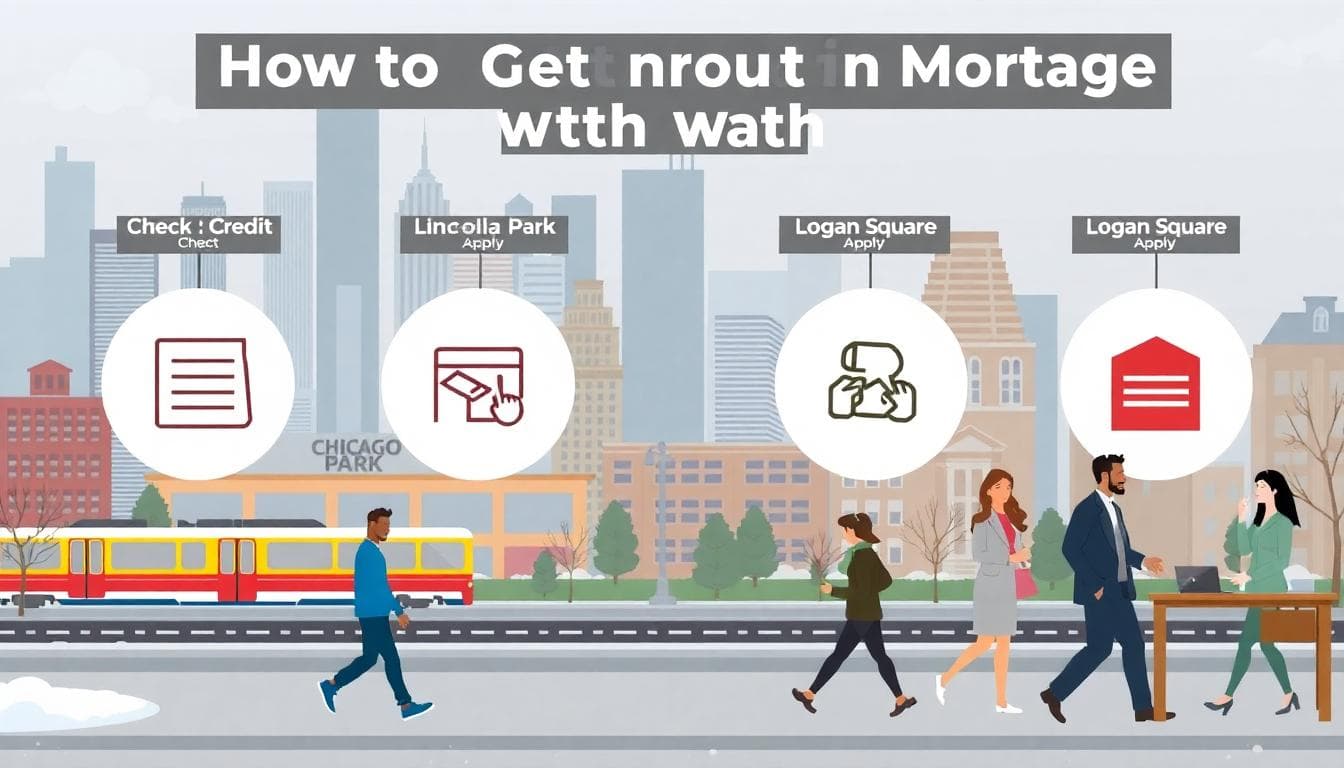 Image created with AI
Buying with less-than-perfect credit in Chicago takes a clear plan and tight execution. We start with fast credit wins, then line up lenders who actually approve low-score files. Timing matters here, since Chicago’s fall-to-winter cycle can tighten appraisals and slow showings. If you want a Lincoln Park brownstone or a Logan Square condo near the Blue Line, this step-by-step approach keeps your file strong, your costs contained, and your commute in mind.
Improving Your Credit Score Quickly for Better Terms
Small wins add up in 3 to 6 months. We attack three levers first: fix errors, pay on time, and drop credit use—while managing overall debt, including student loans, to keep your profile lean. Pull all three reports, dispute mistakes, and get balances below 30 percent of limits. Avoid putting large city bills, like ticket or tax payments, on your credit card, since that spikes utilization. Automate minimums, then snowball extra cash to the smallest revolving balance for faster ratio relief. We have seen 50-point jumps by month three when clients stay consistent. Do this before your Lincoln Park hunt so you qualify for a better interest rate and lower cost of borrowing over the loan term, which can significantly reduce your overall expenses. When evaluating options, it’s key to understand the difference between interest rate and APR: the nominal interest rate is the base cost of the loan, while the annual percentage rate (APR) provides a fuller picture by including fees and other charges, as required under the Truth in Lending Act. Always calculate APR for different rate options to see the true picture—especially if considering discount points to buy down the rate for long-term savings. For a simple roadmap, see Bankrate’s guide on improving credit before a mortgage.
- Quick wins: dispute errors, pay on time, cut utilization
- Timeline: 3 to 6 months for a meaningful boost
Finding and Working with Chicago Lenders Who Say Yes
Target a lender known for approvals with bruised credit. We often recommend Gustan Cho Associates and Lennar Mortgage for flexible underwriting and non-overlay FHA loan files. Ask for application or underwriting fee waivers, and do a comparison of two offers to evaluate origination fees alongside lender credits that can offset closing costs. Investors should request non-QM loan or DSCR options. Tie your case to stable job locations near the L or Metra, since easy commutes can support DTI. Start your file before the holiday rush, when appraisers book out and interest rates can bounce—pay close attention to the APR in those quotes to gauge the full impact. For a broader view of who is active in Illinois, scan the latest list of best Illinois mortgage lenders, then call IHDA-partner shops for down payment help.
Chicago-Specific Tips to Close Your Bad Credit Mortgage Deal
 Buying with less-than-perfect credit in Chicago is about smart tradeoffs and timing. We focus on neighborhoods that fit your payment, then pressure-test the budget for condo fees, taxes, and winter utilities. The goal is a clean approval on your loan and monthly payments you can live with when January hits.
Navigating Neighborhoods and Hidden Costs in Chicago
Lincoln Park commands a premium for schools, lakefront access, and Brown Line convenience. Pilsen often delivers stronger price-per-square-foot value with quick access to the Pink Line and a growing dining scene. Condo buyers should budget for HOA fees, which can push all-in costs higher than expected and impact your APR when factoring in property taxes. Recent reports show Chicago condo fees trending up, which changes your monthly affordability and debt-to-income math—remember, these fees and taxes don’t reduce the principal balance of your loan. See an example breakdown of all-in condo costs in this market from a local source at Luxury Chicago Condos. Add winter utilities to your checklist too, since older masonry buildings can spike heating bills in January and February, further influencing your overall APR.
Timing Your Purchase Around Chicago’s Seasons and Trends
Spring brings more listings, better showings, and faster appraisals. We aim to go under contract in April or May, then avoid December closings when snow slows inspections and moving—potentially qualifying for seller credits to offset closing costs. Pricing shifted modestly citywide in recent data, though hot pockets can outpace averages, affecting the total loan cost across neighborhoods. Track current city trends with Zillow’s Chicago housing market update. For commuters, proximity to CTA and Metra can offset housing costs by cutting car expenses and parking stress. Suburban buyers targeting UP-North or BNSF lines often find better value with an easy rail ride downtown. Time your rate lock with your lender to secure a favorable interest rate and inspection windows to avoid weather delays, as higher rates can increase your interest expense over the long-term life of the loan.
Conclusion
We covered the playbook that works in Chicago today. FHA loans, VA loans, non-QM, and select IHDA-assisted options give real paths with scores under 600, while Illinois 30-year fixed interest rates sit in the mid 6 percents as of October 2025, with many FHA quotes landing in the high 5s to low 6s. Follow the steps you saw here, build quick credit wins, pick a no-overlay lender, and pressure-test the budget for the cost of borrowing, HOA fees, taxes, and winter utilities.
Keep it local and tactical. Most Chicago lenders charge between 2,500 and 5,000 in origination fees on a 500,000 purchase, so ask for lender credits, compare fees across two to three shops—including the APR and annual percentage rate to look beyond the stated interest rate—and pair seller credits with a clean file. Choose homes that fit your commute and DTI, near the Brown or Blue Line, close to Metra UP-North or BNSF if you are suburban, and weigh garage parking in River North or Lincoln Park since winter shifts pricing and comfort.
We have helped hundreds of Chicago families close this year, even with bruised credit. Book a free consult, or reach out to your short list of lenders today, then lock a plan before the next cold snap slows inspections and appraisals—understanding the total loan cost is crucial. Your next step is simple, get preapproved, set a budget, and shop block by block. The keys to your favorite neighborhood, from Logan Square to Pilsen, are within reach.